Description
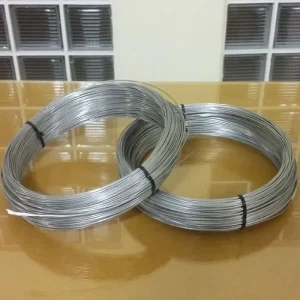
NiCr alloys (Nickel-Chromium) are widely used in heating elements where mechanical flexibility and stable resistance are required. They offer excellent ductility at oxidized state and perform very well under repeated heating and cooling cycles.
Maximum continuous element operating temperature: 1200⁰C
Electrical resistivity (20°C): 1.09 Ω·mm2 m-1
Density: 8.4 g/cm³
Emissivity in fully oxidized condition: 0.88
Non magnetic
Composition: 20% Cr – 80Ni
NOTE: The data above are extracted from the producer (Kanthal) official datasheets.
*Important Trademark Information: Nikrothal® 80 is registered trademark of Sandvik Materials Technology (Alleima). Any reference to this trade name is made solely for identification and descriptive purposes.
Genuine Kanthal® material, cut and repackaged by Thermansys.
Key Advantages
- Excellent workability and formability
- Have higher hot and creep strength than FeCrAl alloys
- Very good oxidation resistance
- Remain ductile after long use
- Moderate resistivity increase rate versus temperature (7% at 1200C)
- Good resistance to thermal cycling – frequent heating cycles
- Ideal for compact and dynamic heating systems
- Fully oxidized NiCr alloys have a higher emissivity than FeCrAl alloys. Thus, at the same surface load the element temperature of NiCr alloy is somewhat lower
- NiCr alloys have better wet corrosion resistance at room temperature than FeCrAl alloys
- In certain low-temperature applications a non-magnetic material is preferred. NiCr alloys are non-magnetic
Typical Applications
- Cartridge heaters
- Tubular heaters
- Household appliances (ovens, dryers, toasters)
- Hot-wire cutting systems
- Laboratory heating equipment
- OEM heating assemblies
Nikrothal 80 Wire Properties
Material properties used for calculations:
- Electrical resistivity: 1.09 Ω·mm²/m
- Density: 8.4 g/cm³
| Diameter (mm) |
0.4 |
0.5 |
0.6 |
0.7 |
0.8 |
0.9 |
1.0 |
| Resistance (Ω/m) |
8.674 |
5.551 |
3.855 |
2.832 |
2.168 |
1.713 |
1.388 |
| Weight (g/m) |
1.06 |
1.65 |
2.38 |
3.23 |
4.22 |
5.34 |
6.6 |
| Surface Area (cm²/m) |
125.66 |
157.08 |
188.5 |
219.91 |
251.33 |
282.74 |
314.16 |
Note: resistance increases with operating temperature; Kanthal provides temperature correction factors.
The maximum value is 7% resistance increase at 1200C.



Reviews
There are no reviews yet.